
Which power tools vibrate most? Safety aspects to consider
Ever wondered which tools present the biggest vibration risk? Our blog looks at the heavy hitters and what you may need to consider when it comes to vibration.
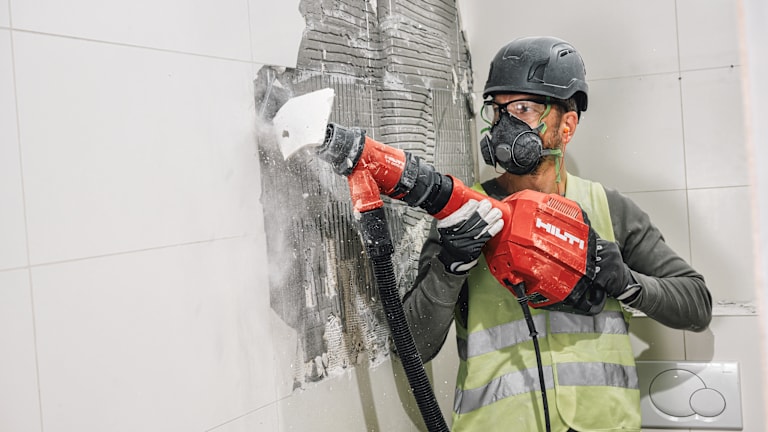
Which power tools vibrate most? Safety aspects to consider
Vibrations are part of life when using power tools. Almost all tools will vibrate in some way and can cause Hand-Arm Vibration if people are exposed for long enough. That can lead to permanent injury of the hands and arms of your employees.
As a contractor, the Control of Vibration at Work Regulations 2005 says you must ‘prevent or reduce risks from exposure to vibration at work’. Reducing time on the tools is one solution, though it can hurt productivity on the job site. Likewise, you could use less powerful tools which vibrate less, although using the wrong tool for the job can present a health and safety risk of its own.
The better option is choosing tools which feature effective anti-vibration technologies to protect your workers no matter how much vibration a task creates or how long they are using the tool for.
The tools most prone to vibration – Demolition, heavy impact, grinding and abrasive tools
The tools which vibrate the most are those which impact hard materials at a high velocity. That can mean repetitive, percussive or grinding impacts which break or alter concrete, masonry, metal or other hard materials.
Tools in this category include:
Breakers (demolition hammers)
Rotary hammer drills (SDS drills)
Chipping hammers
Angle grinders
Cut-off saws
Tools prone to moderate levels of vibration – Saws and sanders
The other category of power tool where users can experience substantial vibration are those used for longer periods or repetitive work. They will usually be applied to materials such as wood or pipework and apply a good amount of power. A portion of that will always be sent back up the user’s arm. These tools include:
Reciprocating saws
Chainsaws
Circular saws
Jigsaws
Orbital sanders
Belt sanders
Hilti’s anti-vibration technology reduces health and safety risks
Hilti’s range of heavy power tools, saws and sanders has been designed to limit harmful vibration in a number of ways which can help you ensure the safety of your workforce in line with regulation.
Lower vibration tools
Many Hilti tools offer a higher than average power output which can help reduce the vibration your workers are exposed to. If a tool is more powerful, it will naturally cause more vibrations. However, that is not the whole story.
You should consider the amount of time a tool is in use for when choosing a tool. If a slightly higher vibration tool means the job take only half the time, the total vibrations the user is exposed to could be lower.
The Hilti team can give you expert advice on choosing the right tool for the job. When it comes to minimising vibrations, the more powerful tool could be the better option.
Active Vibration Reduction (AVR) system
Through many decades of research and development, Hilti has developed Active Vibration Reduction (AVR) systems for our tools. This technology reduces vibration by up to two-thirds compared to conventional tools, allowing them to be used with greater comfort for longer.
Depending on the specific tool, the way our system works can include:
• Sub-chassis systems – Where the motor is isolated from the external housing through a suspension system, absorbing vibration that would otherwise pass directly to the user.
• Vibration absorbers – Counterweights oscillate to counteract, reducing the vibration which reaches the operator's hands.
• Decoupled handles – Separating the vibrating section of the tool from the user with a built-in vibration absorber helps to reduce the worker's exposure to vibration.
Choosing tools with Active Vibration Reduction technology can significantly reduce vibration without compromising performance, making it easier to keep construction workers comfortable and productive.