How safety factors are considered in the applied loads for concrete, steel anchor plate, and profile in anchoring calculations? Are applied loads multiplied with safety factors? How HILTI considers safety factors in anchoring calculation? I am using EN approach to calculate anchors but not sure how HILTI considers inbuilt safety factors.
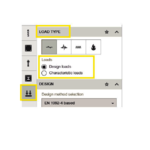
Thank you for your enquiry. Assuming you are using the Profis Engineering software and you are referring specifically to load partial safety factors you have two options regarding your inputs:
1) Design / Factored load where you have already applied your load partial safety factors
2) The Characteristic / Unfactored load in this situation the software will apply the load partial safety factor(s) based upon the National Annex requirements of the selected country.
Material safety factors will be as per the Eurocode 2 Part 4 and these factors can also be found within the selected products European Technical Assessment.
Please find attached the screenshot for loads safety factors. Are these loads multiplied with 1.35 and 1.5 factors and then HILTI applies those loads? eg. if my loads are like Fx=50 N, Fy=50N Fz= 50N, Mx= 50Nm, My=50Nm, Mz=50Nm. And safety factors for permanent load and variable load are 1.35 and 1.5. Is it like 1.35*1.5 = 2.0
A total safety factor is 2.0
so all loads are multiplied with this safety factor
eg. Fx=50*2 = 100 N, and similar for all other direction loads.
HILTI will apply Final load on model is 100 N in X direction.
Please let me know how it should calculate load and applies on model?
Thank you for the follow up question. When using the Profis Engineering software you can select to use either Design Loads or Characteristic Loads - You will find this in the attached screen shot.
For example if you select Design Loads the software does not apply any additional load partial safety factors to the inputted values, as you have already applied them previously therefore the load(s) is treated as a factored / ultimate load(s).
Now if you select Characteristic Loads the software will then apply the relevant load partial safety factor(s) against that input value(s) whether it be a Dead load (Permanent) or a combination of Dead and Live (Variable) load and will then perform the anchor check against those values.
This will also apply irrespective of whether the load direction is a tension, shear moment or torsion.