
For interface shear design, Hilti Calculation is defining the
embedment depth based on the yielding force in the rebars rather than the
actual utilisation. It means adding more and more anchor bars doesn’t reduce
the embedment depth, and only reduces the utilisation. On the other hand the
embedment depth for tension rising from shear is get calculated based on the
actual forces. In this case, addition more anchor bars reduces utilisation and
embedment depth should be reduced with adding more anchor bars, can you please
share your suggestion? EC1992-1-1, clause 6.2.5(1) says the reinforcement only
need to have ADEQUATE anchorage.
In the attached calculation the embedment depth for interface shear is 758.2mm but the utilisation is 68%, can the embedment depth be reduced to 0.68x758.2= 515mm?
Thank you,
Mehrdad
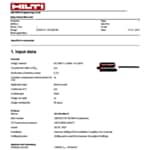
Thank you for your enquiry and file. Looking at the attached pdf file your connection is an end anchorage which is subject to a shear load only. In this case the concrete has been modelled as being roughened to create a concrete interlock between the existing and new concrete.
The roughened interface creates a friction interlock from which the Design Anchorage Length (Tension / compression (axial ) forces are transmitted from the concrete to the post installed reinforcement along the embedment length , lbd , For
your case as there is no bending moment or additional tensile load applied the transfer of the shear load for an End anchorage application is governed by EN1992-1-1 Section 6.2.5 (Predominant compression and shear )
Having said that your case the end anchorage that the design method the software is modelling is using EN1992-1-1 Section 8.4.4 when calculating of the Design anchorage length.
As a separate note the connection as modelled is failing, please see pages 6 and 17 of the report.
Thank you for your response. In another words my question is why Profis doesn't reduce the embedment depth if the utilisation is lower than 100%? but if the interface shear design is not chosen, it does reduce the embedment depth. For example, if there is a case where the interface shear requires 6 H32 bars with 100% utilisation and an embedment depth of 660mm. If 3 additional bars are provided, the utilisation will decrease to 67% but the embedment depth stays same as before 660mm. Can the embedment depth be reduced as the reinforcement are not fully utilised? Is there any option in Profise to consider that effect?
Thanks for the follow up, the software does calculate reduced embedment depths. For example, I quickly revisited your design and attach a pdf for your review which is based upon 12 number 32mm bars. The top two rows require an embedment depth of 320mm (I suspect this could be reduced to a single row) and the bottom two rows need a slightly deeper depth of 584mm with the bar working at a higher utilisation.
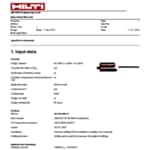
In calculation you shared, the "Verification of interface shear" has been turned off. If it is turned on, then all the embedment depths will increase to 660mm. And if you try to add more reinforcement, the embedment depths don't reduce. Would you please share a revised calculation and clarify if there is any way to reduce the embedment depths while the "Verification of interface shear" is turned on?