
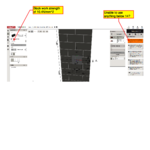
I would like to carry out a check for blockwork of compressive strength 10.4N/mm^2 with dimensions 440x100x215dp. However, the online software is only allowing me to put in a minimum value of 14N/mm^2 and will not carry out any calculations below 14 (See screenshot 1). How am i able to carry out a check for typical strengths of 3.6,7.3,10.4 strengths? . Second question, I generated the report with 14N/mm^2 in order to see what the calculations were doing. Within the input data section, for the base material. It shows the strength of 14N/mm^2, however the prefixes are f b,v. (which denotes Shear strength), this differs from compressive strength and is significantly lower. The printout would suggest that the blockwork would then have a compressive capacity of 93N/mm^2? ( 14N/mm^2 (fb,v) = 0.15(reduction factor) x 98N/mm^2(fc)) (see screenshot 2). Could you kindly clarify this.
Thanks for your question. The selection of base material in the masonry module of Profis Engineering is based upon units with a compressive strength that we have physically tested. If you cannot match your unit against one, we have tested i.e. it has smaller physical dimensions or is of a lower compressive strength then you would need to carry out onsite testing to establish the allowable loads. Please refer to BS8539:2012 or the latest state of the art guidance note 2024 as published by The Construction Fixings Association.
In cases where you have a 140mm thick block then you can look at alternative units such as the Vbl and Vbn concrete brick units which are slimmer than 140 but greater than 100 and you can adjust the compressive strength to higher compressive strength and the larger block dimensions. So, to reiterate if you have 100mm thick blocks you would need to test.
Why don't you test the fixings in 140mm 7.0N/mm2 block which is by far the most commonly used block spec