
Hilti Handbook for Steel-To-Concrete connections using post-installed systems.
Designing safe, compliant steel‑to‑concrete connections requires more than just selecting an anchor—it demands the right engineering approach. Read more to find out how Hilti can support you.

Introduction
Post-installed anchors provide necessary flexibility for modifications, repair, addition of new steel structure to existing concrete structures cast at a previous point in time ensuring the connection is securely established. This technology can be used in a wide range of applications including structural and non-structural connections with simple installation and contribution to sustainable construction practices complying to modern standards. For steel to concrete (S2C) connections, post-installed anchors create reliable, safe and code compliant solution maintaining structural integrity of primary, secondary, temporary structural and non-structural applications.
Highlights from the book
This Handbook aims to provide an overview of working principle, factors influencing performance, qualification and assessment guidelines, design details followed by some examples with calculations, software and tools for design and installation of post-installed anchors. The Handbook is written and presented in a user-friendly and comprehensive way to provide guidance to the engineers involved in designing S2C connections. Furthermore, it is also useful for contractors, in-house technical teams and others who are directly or indirectly associated with such applications.
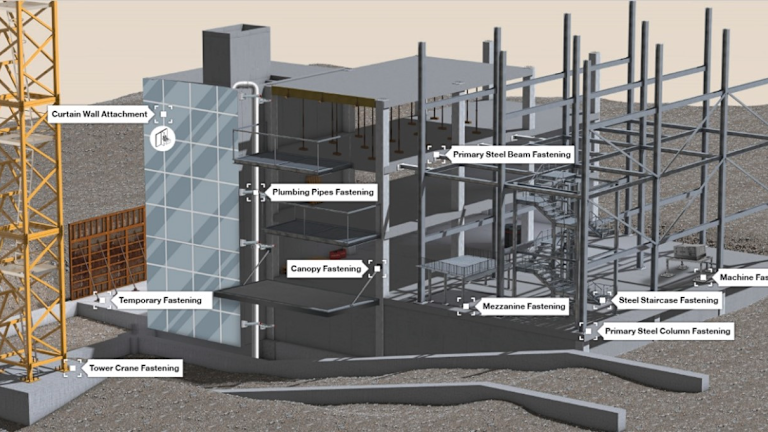
After a brief introduction, Chapter 2 focuses on the applications, definition of different type of structural and non-structural connections and elements of fastening systems.

Fig. 2.1: Different types of connections

Fig. 2.2: Elements of fastening in steel-to-concrete
Chapter 3 describes the types of post-installed anchors (mechanical, chemical and combined system) along with their working principles, influence of several factors (condition of concrete, environment, installation, loading etc.) on performance of anchors, loading types and directions which anchors can experience during their working life.

Fig. 2.3: Classification of post-installed anchors

Fig. 2.4: Load bearing mechanism in fastening technology
Chapter 4 talks about the qualification and assessment criteria defined in relevant European Assessment Documents (EADs), design summary in standards including EC2-4, EOTA Technical Reports and product performance mentioned in European Technical Assessments (ETAs).

Table 2.1 Details of design and assessments

Fig. 2.5: Design and qualification scope briefly defined
Chapter 5 showcases the main Hilti solutions mentioning the key properties and available sizes. It describes the main three phases of construction workflow considering design and installation of anchors as well as their inspection.

Fig. 2.6: Hilti as total solution provider
Chapter 6 is dedicated for detailed design method, design examples using Hilti latest products against relevant failure modes for different load cases (static / seismic / fire / fatigue) under the scope of EC2-4 and other complementary EOTA TRs.

Fig. 2.7: Design concept (amplifying action and lowering down resistance)

Fig. 2.8: Verifications against failure modes in tension, shear loading

Fig. 2.9: Design checked in PROFIS and snapshots presented
Chapter 7 covers the features of Hilti PROFIS Engineering, cloud-based structural engineering software for code state-of-the-art code compliant anchor design. The main features including modelling of the application, definition of loading and environmental and loading conditions are described. Additionally, the most advanced and realistic simulation of the steel baseplate with the component-based finite element method (CBFEM) is highlighted.

Fig. 2.10: PROFIS, the design software for complete S2C baseplate and anchorage applications

Fig. 2.11: CBFEM analysis and sample design report in PROFIS
Chapter 8 describes all relevant steps of installation process, use of proper tools, technologies (SPEC2SITE), jobsite services, inspection, onsite testing and quality control process offered by Hilti.

Fig. 2.12: Steps for proper installation

Fig. 2.13: Use of latest tools, jobsite services, spec2SITE
Chapter 9 presents some worldwide projects of S2C applications with highlights on the support and end-to-end solutions provided by Hilti.

Fig. 2.14: Reference projects highlights
Ready to read the whole book, find it here
References
EN 1992-4-Eurocode 2 - Design of concrete structures - Part 4: Design of fastenings for use in concrete, Brussels: CEN, 2018.
R. Eligehausen, M. R and F. J. Silva, Anchorage in Concrete Construction, Berlin: Ernst & Sohn GmbH & Co. KG., 2006.
fib bulletin 58: Design of anchorages in concrete, Lausanne: IFSC, 2011.
EN 1992-1-1:2004-12: Eurocode 2 - Design of concrete structures - Part 1-1: General rules and rules for buildings, Brussels: CEN, 2004.
Eurocode 2: Design of concrete structures - Part 1-2: General rules - Structural fire design, Brussels: CEN, 2004.
Eurocode 8: Design of structures for earthquake resistance -Part 1 : General rules, seismic actions and rules for buildings, Brussels: CEN, 2004.
EN 1990:2002+A1: Basis of structural design, Brussels: CEN, 2005.
EOTA TR 061: Design method for fasteners in concrete under fatigue cyclic loading, Brussels: EOTA, February, 2024.
EOTA TR 075: Design of bonded screw fasteners for use in concrete, Brussels: EOTA (in preparation).
EOTA TR 082: Design of bonded fasteners in concrete under fire conditions, Brussels: EOTA, April, 2024.