
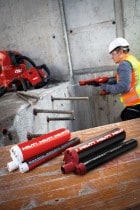
The best epoxy resin for your post-installed rebar application
The worlds 2nd resin for use in accordance with TR069
In 2020, Hilti launched the 1st hybrid chemical anchor, HIT-HY 200-R V3 with the European Technical Assessment (ETA) according to EAD 332402-00-0601 for design in accordance to TR069 ‘Design method for anchorage of post-installed reinforcing bars with Improved bond-splitting behavior as compared to EN1992-1-1’.
Since then, it has become a popular choice when designing for moment-resistance concrete connections (see figures below) and we are often asked – how about the epoxy resin?
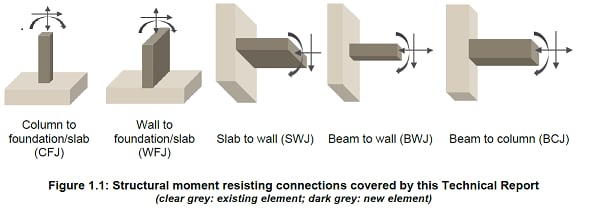
Hence, with the introduction of Hilti HIT-RE 500 V4 in autumn 2021 and being the second resin in the market that is assessed according to EAD 332402-00-0601 for TR069 design method, we are going to help you tackle every type of application in every project!
How to choose the product for my project: HY 200-R V3 vs RE 500 V4?
Both resins cover the design method EN 1992-1-1 and TR 069 while the biggest differences are:
1. Working & curing time
2. Rebar diameter and max. embedment depth
3. Various jobsite conditions
We recommend that engineers and customers select the right product for your project based on:
1. Temperature during construction: HIT-HY 200-R V3, with its shorter and faster curing time, is the best option for use in colder climates.
2. Rebar diameter & embedment depth: HIT-RE 500 V4 covers up to 40mm rebar, max 3.2m embedment and with its slow curing characteristic, it's the perfect solution for large or deep rebar installation
3. Jobsite and borehole condition: HIT-RE 500 V4, being a robust epoxy, works well in tough conditions, such as wet or diamond-drilled holes.

If you would like to start designing as per TR069, visit our webpage for the PROFIS Rebar design software by clicking here
More product information of the HIT-HY 200-R V3 can be found here
More product information of the HIT-RE 500 V4 can be found here
If you would like to find out more then why not ask, or leave a comment below.