
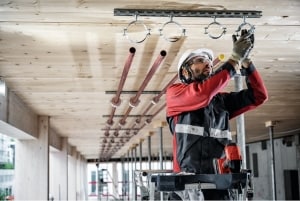
Redundant fastening in cracked concrete
Selecting a safe and compliant anchoring system for your light-duty MEP applications
Mechanical, Electrical, and Plumbing (MEP) systems are the backbone of many building infrastructures, providing essential services like HVAC, electrical power, and water supply. Trapeze supports, as an example, are commonly used to suspend these systems to provide stability and functionality. In addition, lines and grids of single-point fastenings, including suspended ceilings, are also applicable support methods. With these various support systems, a redundant fastening approach can be important for safety, system reliability, and functional recovery.
What is Redundant Fastening?
Redundant fastening involves incorporating multiple layers within the load path of a fastening system to prevent failure. In trapeze supports, this might include secondary clamps or backup nuts. In lines and grids of single-point anchor fastenings, redundancy is afforded by building in assumptions that a percentage of the fastening points could fail and still have their load transferred sufficiently to adjacent anchors. In this article, we will investigate the aspects of anchors to complement the primary support mechanism. This approach ensures that even if one anchor fails, the system remains intact and functional.
In most installations of MEP services to concrete, these services are installed to the ceiling, or the “under side” of the concrete slab or element, often referred to as “cracked concrete zone” or “tensile zone”, as the tension due to bending occurs here. Despite the fact that the rebar embedded in the concrete is taking up the stress from the bending slab, cracks in the concrete may still occur, often as “microcracks” as they sometimes are difficult to detect by the bare eye.
Even microcracks can influence the type of anchor we chose for an MEP fastening system. If an anchor not qualified for cracked concrete use is installed and put under stress in a crack, a failure can occur before the full capacity of the anchor has been achieved.
The Importance of Redundancy in MEP Supports
It is significant to understand how the MEP service will behave in the case of a failure of one of the fastening points. If one anchor fails to carry the load from the piping system in its anchor point due to poor concrete or cracks, and this causes a slip or failure, the adjacent anchors must be designed to be able to carry this additional load without causing cascading failures of other anchors that could produce catastrophic outcomes.
CEN/TR17079 provides design guidance for post-installed fasteners for fixing redundant non-structural light weight systems with at least three fixing points. The fixing may be into normal weight concrete or precast prestressed hollow core slabs. However, the report does not give any guidance to what type or manufacturer of anchors to be used, hence, it is important to know how to select a safe and reliable solution.
In the technical data sheet for an anchor tested and approved for redundant fastening applications such as the HUS3/IQ which is our new “push to fit-anchor” or the Hilti HKD Flush anchor, it should clearly say how to calculate the minimum number of anchors and what load the anchor and anchor points can be suitable for. See an example of this below and follow these links to the ETAs and technical data sheets.
HUS3/IQ ETA
Technical data sheet HUS3/IQ
Technical data sheet HKD Flush anchor
Some important aspects to consider when selecting anchor solutions for redundant fastenings include the following:
Enhanced Safety
MEP systems are often installed above ceilings or in inaccessible areas. If a support system fails, it can lead to falling equipment or pipes, posing significant safety risks to building occupants and maintenance personnel. Designing anchors for redundant fastening reduces the risk of such catastrophic failures.
Cost Savings in the Long Term
While redundancy in anchoring might slightly increase initial material and labour costs, it prevents expensive failures and downtime. Repairing a failed MEP system or a suspended ceiling often involves costs such as removing suspended ceilings or surrounding installations, disconnecting heating/cooling supply, costly down time and additional cost for labour and rent of lifts. Such additional costs can be mitigated by installing a robust, redundant system from the start.
Conclusion
In designing MEP trapeze support systems or suspended ceilings, redundancy is not just a precaution—it is a necessity. A redundant fastening approach ensures that the system can endure unexpected stresses, minimize safety risks, and operate reliably over its intended lifespan. By prioritizing redundancy, engineers and contractors can create support systems that uphold the integrity of critical building services, protecting both occupants and investments. Hilti redundant solutions for MEP systems provide peace of mind that the attachment and its components will remain safe, reliable, and functional during the design loading event.
For more information, reach out to your sales or engineering contact or call your local Hilti customer service office. Visit www.Hilti.co.uk today to learn more about how Hilti can support you in designing safe and more productive anchoring systems
Hilti Installation portfolio
HUS3-IQ push-to-fit anchor
Are you interested in learning more about the support we can offer with modular support systems, you can find more information here or contact 0800800100 to be put in contact with your local engineer.
You are also welcome to ask us for support: simply leave a comment or post your question in the community, or improve your knowledge and skills via our Webinars or training sessions.
For the latest news in engineering solutions and innovations follow us on: LinkedIn, Instagram and X