
Direct fastening solutions
Introduction
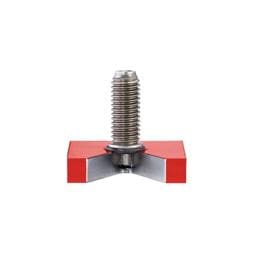
Hilti’s fastening on steel studs are used as fasteners to attach architectural, structural, mechanical and electrical systems to steel base material. Some of the solutions, namely the X-BT studs, require a pre-drilling of the base material to have a proper fixing of the studs. In Figure 1 it’s shown a pipe support fixed to a steel beam through X-BT studs (left) and a cross-section representation of a connection of a stud to the base material (right).


Figure 1 - Pipe support fixed to a steel beam through X-BT studs (left) and a cross section representation of a connection of a stud to the base material.
This article presents a summary of the analysis Hilti has done to assess the influence of drilled holes and fasteners (in this case X-BT) on the static stress-strain characteristics of construction steel.
Structural steel properties and design
The main properties of structural steel are the yield strength, ultimate strength and ductility.
The yield strength  is the stress from which the material exhibits a permanent deformation. In steel, this is the point where elastic behavior transitions to plastic behavior, meaning the material will no longer return to its original shape when the load is removed. The ultimate strength
  is the maximum stress that the material can resist before necking (localised thinning) begins, which leads to eventual fracture. It represents the peak of the stress-strain curve. Ductility refers to the material’s ability to undergo significant plastic deformation before fracture. A ductile behavior ensures that steel structures have adequate deformation capacity to redistribute stresses and absorb energy under dynamic or extreme loads [1].
In Figure 2, it’s represented a schematic stress-strain curve of structural steel, indicating the yield strength and ultimate strength.

Figure 2 - Schematic stress-strain curve for structural steel.
According to the Eurocode 3 [1], the design of steel sections with holes, the tension resistance should be taken as the minimum value of:

In which A represents the gross section of the steel section, Anet represents the net area of a cross section (area discounted with the holes area),  and
and  represent partial safety factors (1,00 and 1,25 respectively) and k is a factor that can be 1,0 (sections with smooth holes, like X-BT) or 0,9 (sections with rough holes or structures subjected to fatigue). In Figure 3 it’s possible to see an example of a section with 2 studs installed in the same section (left) and on different sections (right).

Figure 3 - Example of a steel section (IPE profile) with 2 studs installed: with 2 holes in the same section (vertical – left) and with only 1 hole in the same section (horizontal – right).
Analysing the two equations, we can see that equation 1 does not consider any reduction of the area of the steel profile and equation 2 considers reductions of the section, like holes.
With these equations, we can already have an idea of the impact of the pre-drilling in the resistance of a steel section. For the pre-drilling to have an impact on the resistance, we need to have enough holes (studs) so that equation 2 would be the governing equation (i.e. having a lower resistance when compared to equation 1).
For this, Hilti did an analysis and checked for steel sections IPE 180, IPE 200 and IPE 220 (both for S235 and S275), how many X-BT studs per section we need to have so that equation 2 is the governing one. This information is shown in Figure 4.

Figure 4 - Number of X-BT studs needed to impact tension resistance on different steel sections and steel grades.
Here it’s possible to see that the number of studs needed to influence the resistance of the steel section increases as the area of the profile increases and decreases as the steel grade increases (having a bigger impact).
Hilti’s installation portfolio allows a maximum of 3 studs per section, so X-BT will not impact the profiles analyzed, since it is needed at least 9 studs in a section (IPE 180 with S275 steel) and remove an area of around 12% to have an impact. The detailed calculations for the IPE 180 profile with S275 steel are shown on Table 1.

Table 1 - Detailed calculation of tension resistance for an IPE 180 profile with S275 steel.
Analysis through testing
To complement the information in the previous chapter, Hilti has also performed static tension tests to estimate the impact of the pre-drilling for the installation of X-BT studs in a steel section [2].
The tests were performed with flat steel coupons (see Figure 6) varying the following parameters:
- Base material thickness – 8 and 10 mm;
- Base material strength – S235JR and P355NL1;
- Number of studs driven in the cross-section: either one stud in the center of the coupon or 2 studs within the cross section of the sample were driven (see Figure 5);
- State of stud installation: driven or pulled out.
A total of 16 series of tests were performed.

Figure 6 - Geometry of tension coupons, drill hole geometry and installed state.
As an example, regarding the 10 mm plate of S235 steel, 4 series of tests were done: one for the control plate (no X-BT studs installed at all), one with one X-BT installed in the center, one with two X-BT studs and the last one with one X-BT pulled out. The stress-strain graph for this configuration is shown in Figure 7. The other configurations had similar results, when it comes to the comparison of the influence of the X-BT studs in the steel base material.

Figure 7 - Comparison of stress-strain behavior for the steel plate with 10 mm with S235 steel.
In general the test results allow to conclude:
- There is no effect on the yield level;
- Due to the geometry of the coupon (very small cross section of the sample), the pre-drilling has a considerable impact on the area of the cross section (around 6% for one stud and 12% for two studs). Due to this fact, there is a slight reduction of the ultimate strength;
- Overall behavior remains ductile w/ high strains at maximum force in the range of about 10%.
This article deals with the analysis of the effect of pre-drilling of fastenings on steel studs using 2 methods: theoretical analysis (through Eurocode 3) and a testing approach. The theoretical analysis has shown that a considerable number of X-BT studs are required to have an impact on the tension resistance of the base material.
The testing with the X-BT studs has confirmed that, even with significant reductions of the steel section due to pre-drilling (up to 12% of the section area), the yield strength is not affected, and the base material still shows a ductile behavior.
We also have the S-BT threaded studs, you can view the specification manual here for further information
References
[1] EN 1993-1-1:2022-11 - Eurocode 3: Design of steel structures – Part 1-1: General rules and rules for buildings
[2] H. Beck, M. Siemers, M. Reuter, and E. Schoeffendt, “Stahlbau Kalender – Powder-actuated fasteners and fastening screws in steel construction,” John Wiley & Sons, 2019.