
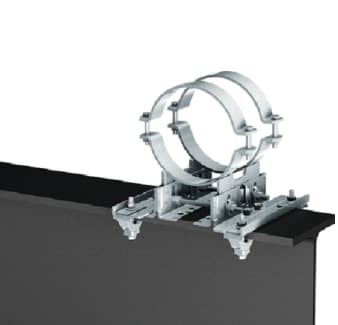
EN 13480-3 Applied to process piping and fixpoint calculator
This article explains Hilti’s offering when it comes to EN 13480-3 with regards to the latest version from 2024. It will help to answer specific questions in comparison with EN 1993-1-1 (Eurocode 3 referred later in this document as EC 3). The focus of this paper is to provide additional information regarding technical data assessments including software solutions and documentation.
Introduction
EN 13480-3 is part of the European standard EN 13480, which specifies the requirements for the design and calculation of industrial metallic piping systems, including primary pipe fasteners such as pipe shoes. The standard ensures that piping systems are designed to operate safely under various conditions such as pressure, temperature, and mechanical stress. This standard was published at the end of 2002 and has undergone several revisions to keep up with technological advancements and industry needs, leading to the latest version published on 2024-12-31 with specific updates regarding.
- Eurocode as normative references
- Modifications to manufacturing of pipe supports – how to design and calculate in accordance with Eurocode.
- Updates in Annex N regarding Documentation of supports.
- Updates in Annex Y where all changes from EN 13480-3:2017/A5:2022 to EN 13480- 3:2024 are shown.
The standard is crucial for engineers and professionals involved in the design, construction, inspection, and maintenance of industrial piping systems. In our comparison we primarily focus on Chapter 13 “Pipe supports” and applicable Annexes. Difference of EN 13480-3 vs EN 1993-1-1 We as Hilti, do support on European Standards referring to primary pipe supports two norms, EN 1993-1-1 which is also known as EC 3 as well as EN 13480-3.
The decision about which standard shall be used, lays with engineering companies and owners for new or existing facilities. With the latest update of EN 13480-3:2024 design and calculation based on EC 3 are also now accepted but only under specific boundaries. EN 13480-3 added a note at the end of chapter 13.11.11 where “Alternative rules for design and manufacture of pipe supports” are included stating that Annex J which covers “Type testing of support components” is not applicable for supports designed with the alternative route according to Eurocode. You can find this nicely confirmed in the below added statement from CEN under question 3-007-2021.*
To be fully transparent in this regard, we do offer technical data for both codes separately from each other while all data is based on test results identified in Laboratories. The identified failure modes out of test results are then taken as a foundation to use them according to standard specific regulations including established and defined safety factors. All these details are included in our locally published tech guides. Detailed information about products and the entire portfolio can be found in here.
Equal to our support system and base fastener portfolio, we publish in our tech guide loads for single directional use only. Whenever three-dimensional loads are to be considered, a specific interaction formula needs to be included. 
Figure 1 Scheme of axes in use for primary pipe fasteners
Under EC 3 we use here a normal linear interaction formula
Under EN 13480-3 which is a more conservative standard compared to EC 3, we use Interaction formula based on “von Mises” yield criterion**
Another element which needs to be considered are temperature reduction factors in correlation with media temperature inside the pipe.
EC 3 does not require a reduction factor up to 300°C while EN 13480-3:2024 provides material properties for carbon steel according to EN 10025 series (S235, S275 and S355) in the range from 0°C up to 350°C directly in Appendix G.4. In here a graph is included which shows temperature reduction factors from 100°C media temperature onwards.
In addition to that Table 13.11.2-1 shows “Design temperature of components within the insulation”. In general, all support components shall be designed with at least 80°C design temperature. For “components without direct contact with the pipe” the design temperature can be reduced by 20°C if the final value is still above 80°C overall.
This means for our offering that Hilti pipe shoes where manufactured pipe clamps bows are based on S235 steel can be used according to graph in Appendix G.4. Whenever our complementary offered inlay bands are used between the pipe and pipe clamps bows, the mentioned reduction of 20°C out of Table 13.11.2-1 can be considered prior to the identification of the final used temperature reduction factor. So, in such combination no reduction factor is being needed until 120°C media design temperature at all with our offering in alignment with EN 13480-3.
Further transfer of media temperature towards components in the entire support structures must be assessed based on being inside or outside of insulation to ensure that all used components can withstand the specific temperatures at their locations. (Table 13.11.2.2 and Figure 13.11.2.1)
Overall EN 13480-3, even in the latest version in most real-life cases, tends to be more conservative than EC 3. On the other side there are also options to exceed published loads whenever stress levels in the pipe described do include so called “occasional loads” as defined in chapter 13.1.3.16. This means that a support designer, not the pipe support manufacturer like Hilti, can assess if any loads at the specific facility and isometric can be assessed like being treated as occasional. As an example, this could be a higher short notice temperature during maintenance or wind / snow loads depending on specific circumstances on site.
As it is quite comprehensive to cover all these needs and challenges in one calculation, Hilti started to cover this in our established FixPoint Calculator software.
Hilti FixPoint Calculator covers EN 13480-3
Hilti FixPoint Calculator is a specialised software tool designed for engineers and professionals working with piping systems. It adheres to the EN 13480-3 standard, which is crucial for the design and calculation of metallic industrial piping. Hilti FixPoint Calculator simplifies these complex calculations, providing detailed reports and intermediate results that help engineers validate their designs and ensure compliance with the stringent requirements of EN 13480-3. This makes it an invaluable tool to help ensure safety and efficiency in piping projects.
The EN 13480-3 standard can be found in the direct load input application. 
Figure 2 Starting page in FixPoint calculator software
In this application you can enter support loads in all three directions. No additional reduction factor is applied.
The maximum working temperature and temperature reduction factor according EN 13480-3 are applied to the entire pipe shoes and their connection elements uniformly. 
Figure 3 Specific input fields in alignment with EN 13480-3
The following interaction formula is used in FixPoint Calculator for all pipe-shoes MP-PS 1-1 single pipe shoes and MP-PS 4-2 two leg double pipe shoes and the clamps: 
For MP-PS 2-2 double pipe shoes, the load capacity depends on distance between pipe axis and girder. Here is the interaction formula for a height below 250 mm:
And for a height above 250 mm:
Documentation under EN 13480-3
Proper documentation is key in process piping industries. Now the standard includes two tables in Annex N, under Table N.1 for pipe supports fabricated according to EN 13480- 3:2014 and Table N.2 pipe supports according to EN 1090-2:2018 +A1:2024
In both tables three support classes from S1-S3 are included to clarify in depth which documents must be supplied or made available for review if required.
Conclusion and Recommendations
Hilti is happy to support you during your piping projects which specific details and technical support upfront as well as physical support on site to ensure smooth project progress.
For more information, please contact your local HILTI experts and check out other articles on this topic.
* Answers from European Committee for Standardisation CEN
**Multiple axes stress von Mises yield criterion: von Mises yield criterion - Wikipedia