

An explanation of the design method when considering the design life.
For the background on European regulatory framework on design working life, please visit the previous article here
Design method
Good news, the design method is the same for both 50 and 100-year service life and depends on the type of application – whether it is an extension (e.g. slab extension) according to EC2 or an intersection (e.g. slab to wall connection) according to TR069*.
*Please read this article for more information on TR069 design method
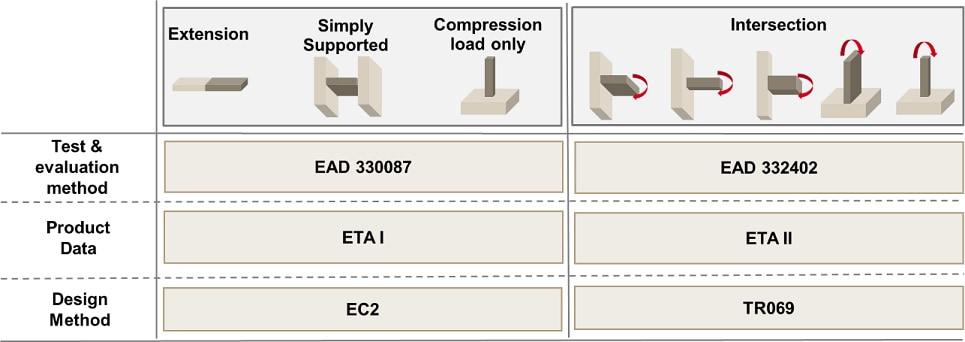
Watch out though, as shown in the above table in post-installed rebar application, there could be at least two ETAs for the same product, a product that owns the ETA for 100 year service life for design according to EC2 does not mean that it owns the ETA for application with design in TR069.
Pay extra attention to the details listed in the product specific ETA. (Read this article to see how to spot it)
Hilti HIT-HY 200-R V3 and HIT-RE 500 V4 are fully equipped with ETA in
- both design methods (EC2 & TR069) and
- 50 & 100 year service life
Difference on design 50 vs 100 year service life
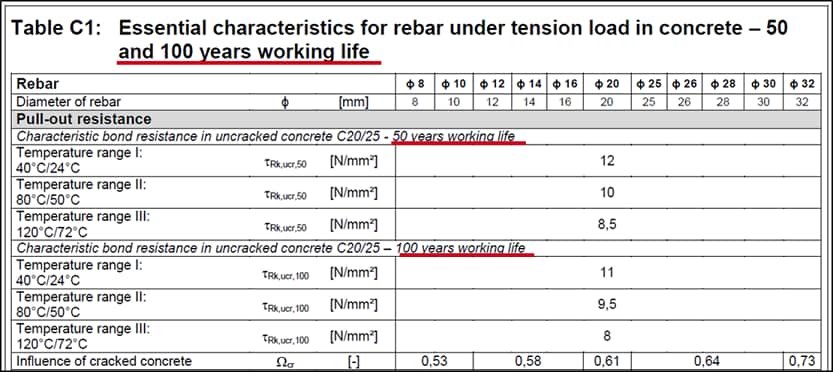
Thanks to the robust recipe in the Hilti HIT-RE 500 V4 and HIT-HY 200-R V3, the performance data (a.k.a. bond value) of 50 & 100 year service life design are the same when the application is designed according to the EC2 method while there is a very small drop of performance when the application is designed according to TR069. (please see below example from HY 200-R V3 ETA-19/0665).
For full details, please read the product’s ETA.
Design with service life requirement
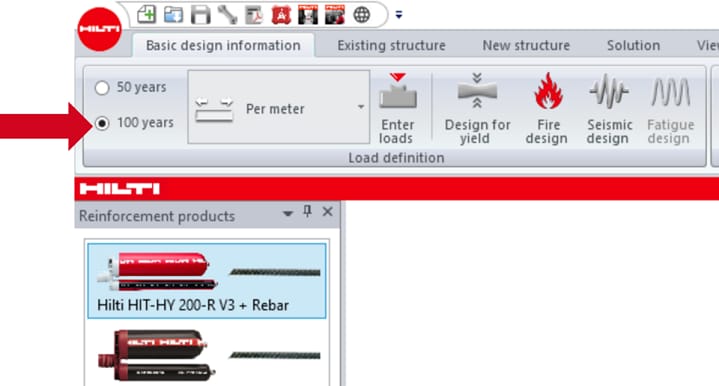
Simply select the relevant service life requirement when you are using the PROFIS Rebar design software. The software will choose the right performance data for your calculation.
If you would like to find out more then why not ask, or leave a comment below.