
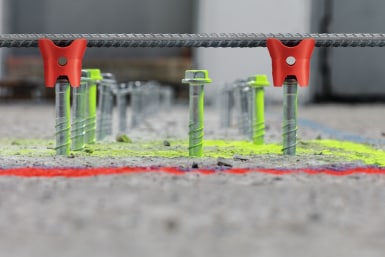
Regulatory framework & differences between EN1992-1-1 and TR066 on Concrete Overlay
Code background
The current European standard for the design of reinforced concrete structures EN 1992-1-1 (EC2) contains rules for the design of the shear capacity of concrete/concrete joints of semi-precast concrete elements.
However, for the design of reinforced interface with post-installed shear connectors, EOTA TR066 ‘’Connector for strengthening of existing concrete structures by concrete overlay’’ is the appropriate and state-of-the-art design approach. The TR066 allows the design and dimensioning of these connections and the interface considering three load-bearing components (cohesion/friction, interlocking and dowel action) and other product-specific factors.
EOTA TR066 cover
Differences between EN1992-1-1 and TR066 on concrete overlay
While EN 1992-1-1 (EC2) only considers cohesion, the external stresses and friction, the new EOTA TR 066 also considers the dowel effect of the post-installed shear connectors. This is necessary because in case of a relative displacement of the concrete
layers, the stresses from both loading directions are superimposed in the shear connector and thus the usable axial tensile force is considerably reduced. This behaviour depends on the product.
Furthermore, EN 1992-1-1 (EC2) assumes a sufficiently anchored shear reinforcement, as it is known from semi-precast concrete elements, and for this reason steel yielding is considered as the decisive failure mode. In contrast, EOTA TR 066 considers the individual failure modes of post installed shear connectors. Consequently, the steel stress of the shear connector calculated from the design resistance under tension is used instead of the yield strength when applying the shear verification. The design resistance under tension is equal to the decisive resistance taking into account all possible failure types determined according to EN 1992-4-11.
Product qualification for design according to TR066
The load-bearing behavior of the post-installed shear connectors is product specific and cannot be determined theoretically. It is determined in accordance with the European Assessment Document depending on the type of shear connector by EAD 330232-00-0601 (concrete screw as anchor), EAD 330499-00-0601 (bonded anchor as anchor) and EAD 332347-00-0601 (shear connector). Qualification as a fastening element or anchor is therefore not sufficient for a design according to EOTA TR 066.
Hilti HIT-RE500 V4 HCC-B chemical anchor system and the Hilti HUS 3 screw are currently the two products that offer such an ETA in accordance to TR066.
In summary, EOTA TR 066 represents a state-of-the-art design concept for the design of shear joints (concrete overlay) with post-installed shear connectors.
You are also welcome to ask us for support: simply leave a comment or post your question in the community, or improve your knowledge and skills via our Webinars or training sessions.
For the latest news in engineering solutions and innovations follow us on: LinkedIn, Instagram and Twitter
This article is part of an ongoing series dedicated to Rebar topics. Find more here