
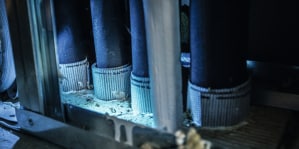
What are the risks and why do you need special solutions?
In most cases, heating, cooling or water supply pipes need insulation. Why? The key reasons are to reduce energy consumption and heat loss, muffle noise transmission and protect against corrosion. In respect of firestopping penetrations, these insulations are very relevant.

Pipe insulations – typical materials and types
Many insulation materials are non-burnable. For example, mineral wool is commonly used and has a density of approximately 40 to 150 kg/m3, making it one of the best insulating materials. Where it is non-combustible, it can achieve the integrity and insulation ratings needed when used as continuous insulation and is used along with a suitable firestopping material to create a fire rated penetration seal. For example, it can be used to seal the annular space between a pipe and a wall or floor penetration when installed per an approved system with a fire rated acrylic sealant. The exact approval will cover factors like the length of the insulation, tested insulation configuration, precise ratings, approved pipe types and diameters, etc. and is always clearly stated in the approval (ETA=European Technical Assessment).

However, many pipes are insulated with some sort of closed cell rubber material. This comes in tubes and can easily be wrapped and fixed around pipe systems. These insulations are very flexible and offer specific condensation burnability. They are suitable for hot and cold water services, chilled water lines, heating systems, air conditioning ductwork and refrigerated pipework. The weak point of Rubber insultation is its combustibility. When exposed to fire, it burns away and leaves an open space between the pipe and wall or floor. As a result, this application requires intumescent material that will close the gap in the event of a fire.
Smarter, more flexible firestop solutions
To solve this particular problem in the area of a penetration, it is important to know that a high-pressure intumescence is not needed. These are generally reserved for applications such as firestopping plastic pipes, where intumescent pressure is needed to crush the pipe as it softens and the firestop closes the gap.
That said, the chosen intumescent material needs to do more than to simply close the annular gap. Most rubber insulations are quite thick and, when they melt will create clear gaps that can allow fire, heat, and smoke to transfer to other rooms in a building.
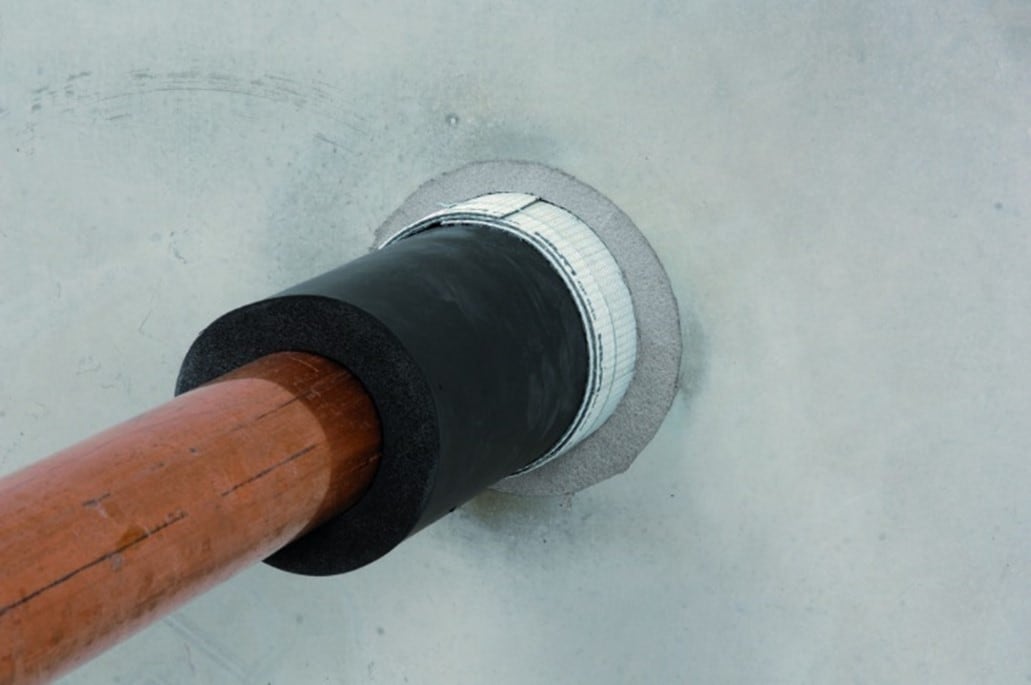
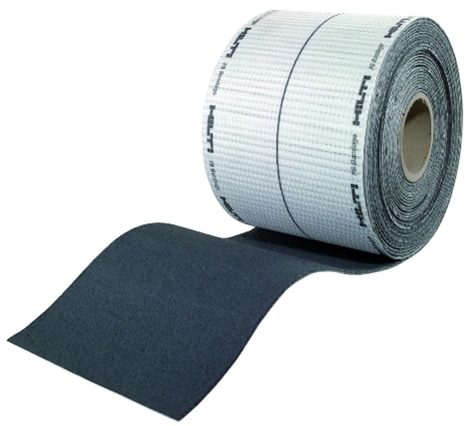
To offer a suitable and flexible solution, Hilti has developed the Firestop Bandage CFS-B. It is only 2mm thick and already comes at a depth of 125 mm. This geometry makes it more flexible and easier to install, thus reinstating the fire performance of the wall or floor. The CFS-B Firestop Bandage can be used for both single or multiple penetrations and can be easily cut to fit the outside diameter of an insulated pipe. The attachment to the insulation is achieved with a steel band or wire, which is supplied with the product. To make sure the system is smoke-tight, Hilti Firestop Acrylic Sealant CFS-S ACR can be used to close the remaining annular gap.
In short, you can use this solution from a single manufacturer and know it is tested according to the stringent EN1366-3 standard and provided with comprehensive ETA ratings.

Watch here to see how to install the CFS-B Firestop bandage.
The big advantage: a broad approval range in the ETA
If you look into the European Technical Assessment ETA-20/0993 of the Hilti Firestop Bandage CFS-B, it becomes very clear its field of application – i.e. all the tested applications covered by fire tests according to the EN1366-3 standard – is unique.
The product covers single penetrations, utilizing just two layers of the bandage in concrete and drywall assemblies. Of course, special insulation thicknesses always must be considered and are generally part of the approved system.
The beauty is that the Firestop Bandage CFS-B can be used to cover many different insulation materials. Hilti always tries to test the most common market applications so it is easier to specify the best solutions. This makes the job of a specifier and installer simpler and easier. For example, the Firestop Bandage CFS-B is appropriate for:
- Elastomeric combustible insulations with butyl rubber-based material
- Glass-fibre mineral wool insulation
- Mineral wool insulation (melting point >1000°C, min.density 45kg/m3)
- Copper pipes with pre-installed WICU flex PE insulation
- Copper pipes with PUR insulations (density 39,4kg/m3)
The variety of approved elastomeric insulations have been tested using well-known products like Armacell’s Armaflex AF, SH, Ultima and HT, as well as other brands including Insul-Tube from NMC Group, Kaimann’s Kaiflex KK and KK Plus. Products from manufacturers like L’Isolante K Flex are also covered.
The Hilti solution is not only tested using the most common insulation materials from the most common manufacturers, but also with a variety of pipe materials and diameters.
For example, it is tested for copper pipes of diameters up to 88.9mm. The ratings vary between EI60 C/U up to EI120 C/U. For higher ratings it may be that additional protection measures need to be taken, like installing additional insulation material around the pipe system. This can be required as metal pipes are quite sensitive to heat transfer, which is a key measurement and a mandatory criterion for being approved.
The same conditions are valid for steel pipes with diameters of up to 114.3mm and pipe wall thicknesses of up to 14.2mm.
While diameters mentioned above are more typical, Firestop bandage was tested with maximum diameter of steel pipe 813 mm in wall and 324 mm in floor.
All details can be found in respective ETA online or in our Firestop Design Software: Firestop Selector.
https://www.hilti.co.uk/content/hilti/E1/GB/en/business/business/engineering/fire-protection/firestop-selector.html
Aluminum composite pipes
More and more, aluminum composite pipes are being used because of their flexibility in use. These pipes are critical when it comes to fire testing as they combine specific behaviors of both plastic and metal pipes. This makes it difficult for firestop materials to pass a fire test with good results. That said, the Firestop Bandage CFS-B has passed many tests involving aluminum composite pipes and can provide good performance for many applications. As composite pipes do not follow a special standard, the fire tests in penetrations have to be done for each specific type of pipe offered by specific pipe manufacturers. In this respect, the Firestop Bandage CFS-B has one of the broadest approval ranges on the market.
These just a few examples of tested pipe systems with burnable insulations: Geberit Mepla, Georg Fischer Sanipex, Kekelit Kelox 110, Rehau Rautitan Stabil, Uponor Unipipe Plus, Viega Raxofix and Sanifix, Tect Teceflex and many more. All approved systems are shown in the respective European Technical Assessment of the Firestop Bandage CFS-B. Most applications are EI120 U/C rated and therefore offer fire ratings suitable for most applications.
Important for installers and specifiers: the distances between different services
Distance between services is a crucial element of many installations. As space is always an issue in planning and designing pipe systems, it can often be a limiting factor. The Hilti Firestop Bandage CFS-B has been tested under conditions that minimize the space between the different services.
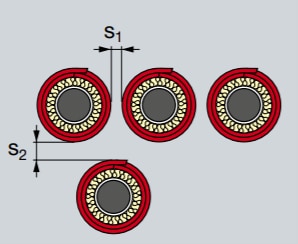
The minimum distance between firestopped pipes with the bandage in a linear configuration is zero (example in picture S1=0). This is a great advantage, saves space, secures stability in an opening and offers planning flexibility of pipe systems. Other distances can be looked up in the European Technical Assessment.
The supporting of services is an important consideration. According to BESA TR50 service supports selection should consider fire conditions. This not only applies to the support materials (channel, strut, hangars) but also to the anchors providing the first point of support. Hilti offers multiple solutions for pipe installation systems including anchors rated for fire and in the cracked zone of concrete. Spacing of the supports is important as the distance from the firestopped opening to the first support has to be specified to safeguard stability in the area of the fire-rated wall or floor. For both walls and floors, the pipes have to be supported / installed at a distance of 250- 400mm from the surface.
Watch here to see how to install the Firestop collar CFS-C EL and the Firestop bandage CFS-B
Summary. The Hilti Firestop Bandage CFS-B
In summary, the CFS-B Firestop bandage is a flexible, comprehensive and versatile product that solves one of the most challenging installation situations: metal pipes with combustible insulation. CFS B offers a broad field of application for this very complex and unique test environment.
However, the fact that very precise situations for specific pipe types are tested makes it quite easy to generate a better and more solid specification with the CFS-B Firestop Bandage. This can be done at an early phase of a project, helping to avoid potentially expensive problems later down the line.
Finally, the CFS-B Firestop Bandage combines easier installation and higher flexibility from a 10m roll meaning one product with a wide scope of application, reinforcing its flexibility in use for tested applications.
Armacell, Armaflex AF, SH, Ultima and HT, Insul-Tube, NMC Group, Kaimann, Kaiflex KK and KK Plus, L’Isolante K Flex, Geberit, Mepla, Georg Fischer, Sanipex, Kekelit, Kelox 110, Rehau, Rautitan Stabil, Uponor Unipipe Plus, Viega, Raxofix, Sanifix, Tect Teceflex: all product and company names are trademarks™ or registered® trademarks of their respective holders.